
Prescient
Webinars
Live Events
Lectures
Seminars
Presentations
Conferences
Prescient Webinars Live Events Lectures Seminars Presentations Conferences
Prescient Events & Industry Engagement
We are always committed to participating in meaningful discussions about industry challenges and collaborating on innovative drilling reliability solutions.
2026 Events
-
01 | A Case Study on the Design and Operational Impact of a Modular Digital Twin for Drilling Rigs with GenAI Component Life Models
A. Wang, P. Acosta, K. Chaudhari, Prescient Devices, Inc.; R. Whitney, Precision Drilling
Abstract. Increasingly ambitious drilling programs continue to push drilling equipment harder than ever before. The repercussions of these demands on equipment reliability require a novel approach to quantify and proactively resolve issues off the operational critical path. This paper reviews a successful solution to quantify asset health, its guiding ethos of targeting the most common points of failure at the component level, incorporation of GenerativeAI (GenAI)) models, and quantifiable rig and financial performance improvements.
02 | A Generalized Drilling Equipment Predictive Maintenance Solution Based on Multi-dimensional Operational Parameters
A. Wang, P. Acosta, K. Chaudhari, Prescient Devices, Inc.; R. Whitney, Precision Drilling
Abstract. This work describes a generalized approach to incorporate real-time operational context into predictive maintenance algorithms. Conventional condition-based and predictive monitoring solutions are designed for equipment operating under a steady state or load. The introduction of a variable load, like those experienced by top drives and mud pumps, substantially increases the rate of detection errors and can be mitigated through automated contextualization using real-time operational data and rig states.
March 17-19 | Houston, TX -
Scaling Challenges For A Large-scale Drilling Asset Health Digital Twin Solution With Generative AI Model
A. Wang, P. Acosta, K. Chaudhari, Prescient Devices, Inc.; R. Whitney, Precision Drilling
Abstract. This work highlights the challenges and solutions in scaling a drilling asset health digital twin solution with Generative AI (GenAI) model to over 100 rigs in under two years while processing 2-billion real-time data points and 60-Million database queries per day. The authors explore the solutions implemented to overcome challenges including distributed data collection, data processing, database reliability, and GenAI model integration. Scaling challenges include: 1) collecting and cleaning multi-source, asynchronous data from disparate data sources across rig sites, cloud-based services, and third-party providers; 2) supporting demanding data processing requirements at a commercial scale; 3) Solving database scaling problems; 4) supporting GenAI Asset Life Model integration; 5) Rapidly iterating with end users and domain experts to drive successful adoption. The project’s business case relied on rapidly scaling the solution to prevent or mitigate an array of failure events which drive down asset reliability and increase total cost of ownership. Upon reaching 30 rigs, data processing stability issues arose which halted expansion. A novel architecture using distributed data processing plus database containers introduced a stable, clean data-layer which enabled scaling from 30 to over 100 rigs.
End-user adoption was prioritized in the project scope as an enabling force to reach the entirety of the rig fleet. Low-code data workflows enabled rapid, iterative development; rapid development cycles provided faster resolution to end-user and domain expert feedback. This feedback varied from pain-points, use cases, and feature enhancements; quick implementation of solutions resulted in enhanced user experience and improved user engagement. Furthermore, legacy workflows were not rewritten but complemented with the new tool. Existing workflows relied on paper ledgers, where the more onerous data entry in a digital workflow reduced the overall effort for the task through automation. The creation of GenAI asset and component life models introduced normalized health predictions across variable operating parameters and regions. These models not only improved rig maintenance decisions but proved critical in assessing vendor performance and subsequent supply chain efficiencies.
January 13, 2026 | Dubai, UAE
2025 Events
-
Improving Drilling Equipment Reliability with Context-aware Predictive Algorithms and GenAI Component Life Models
R. Whitney, Precision Drilling; and A. Wang, Prescient Devices
Abstract. This talk presents a scalable digital twin solution designed to improve drilling equipment reliability amid increasingly demanding operational conditions. Deployed across more than 120 rigs in over two years, the solution reduced equipment-related downtime by more than 75%, failure-related credits by 95%, and normalized operating costs by 38%. Rigs using the system demonstrated a 28% improvement in drilling performance versus peers. This talk discusses the challenges of drilling equipment predictive maintenance caused by dynamic drilling conditions, and the solutions which include: 1) integrating real-time operational context into predictive algorithms; 2) developing a GenAI component life model to predict the Remaining Useful Life of more than 7,200 components; 3) a low-code development framework that enables rapid development and iteration with end users. Additional challenges in data availability, data quality, and solution scaling will be discussed.
December 4 | Aberdeen, UK
-
Building Successful AI Solutions for the Real World
Andy Wang, Ph.D.
Abstract. This talk presents a scalable digital twin solution designed to improve drilling equipment reliability amid increasingly demanding operational conditions. Deployed across more than 120 rigs in over two years, the solution reduced equipment-related downtime by more than 75%, failure-related credits by 95%, and normalized operating costs by 38%. Rigs using the system demonstrated a 28% improvement in drilling performance versus peers. This talk discusses the challenges of drilling equipment predictive maintenance caused by dynamic drilling conditions, and the solutions which include: 1) integrating real-time operational context into predictive algorithms; 2) developing a GenAI component life model to predict the Remaining Useful Life of more than 7,200 components; 3) a low-code development framework that enables rapid development and iteration with end users. Additional challenges in data availability, data quality, and solution scaling will be discussed.
September 24 | Virtual Webinar
-
Career fair and networking event for MIT students, postdocs, researchers and alumni meet representatives of the member companies of MIT.nano Consortium, Microsystems Industrial Group, Quantum Science & Engineering Consortium, MIT AI Hardware Program, and MIT Generative AI Impact Consortium.
September 18 | Cambridge, MA
-
01 | Transformer vs Classical Machine Learning: Harnessing Normalization for Enhanced Asset Life Prediction
K. Chaudhari, Prescient Devices Inc.; R. Whitney, Precision Drilling; P. Acosta, Prescient Devices Inc; A. Wang, Prescient Devices Inc.
Abstract. The advent of artificial intelligence (AI) and machine learning (ML) solutions enable detailed time-series data analysis previously thought impractical to impossible. This paper highlights the development and deployment of a Transformer-based Asset Life Model (ALM) which outperforms previously deployed classical machine-learning approaches for predicting drilling equipment component lifetimes. The use of advanced normalization methods enables consistent performance comparisons across a wide array of assets which may be deployed on different rig types and configurations, geologic basins, and varying operational conditions while offering a flexible framework to accommodate future expansion in data volume and diversity. Furthermore, factors such as manufacturer attributes, like make and model, can be efficiently incorporated and compared. Said features form the cornerstone of insights which influence supply chain and operations optimization efforts which resulted in a 40% reduction in operating costs. This paper presents a novel Context-Conditioned Normalization (CCN) layer, the supporting technical stack - from data governance through hyper-parameter optimization, ML Operations (MLOps), and field rollout - offering a blueprint for industrial-scale deep learning.October 21, 2025 | Houston, TX
02 | Condition-Based Maintenance in Drilling Rigs: A Holistic Framework to Address Operational Context, Early Failure Detection, and Predictive Lifecycle ManagementL. Wang, Y. Krasnikov, Nabors Industries; A. Wang, K. Chaudhari, Prescient Devices Inc.
Abstract. Drilling rig equipment operates under highly variable load conditions, making traditional sensor-only Condition-Based Maintenance (CBM) systems prone to false alarms and limited in predictive capability. This paper presents a holistic, context-aware CBM framework that integrates multisensing technologies - ultrasound, vibration, and temperature - with operational context data such as rig states and Electronic Drilling Recorder (EDR) channels. The goal is to enable both early fault detection and long-term Remaining Useful Life (RUL) estimation through a scalable digital twin architecture.
October 22, 2025 | Houston, TX -
01 | How Can We Leverage Shared Knowledge to Drive Down the Cost of AI Tools Across Our Industry?
Moderator: Robert Van Kuilenburg, Offshore Performance Improvement Manager, Noble CorporationAutomation, AI and related tools are promising tools to bring more efficiency to our business, with a lot of examples showing specific advantages. At the same time it seems implementation of AI at scale has run into roadblocks, with few positive examples. The panel will discuss the reasons behind this difference, is it the technology or more business structure related? How could different players collaborate to leverage experience gained, with the goal of reducing the overall cost of automation and AI and improve the “at scale” implementation.
Emmanuel Segui, Head of Rig Support, TotalEnergies
Andy Wang, Founder & CEO, Prescient Devices
ChatGPT
02 | AI Technical Session
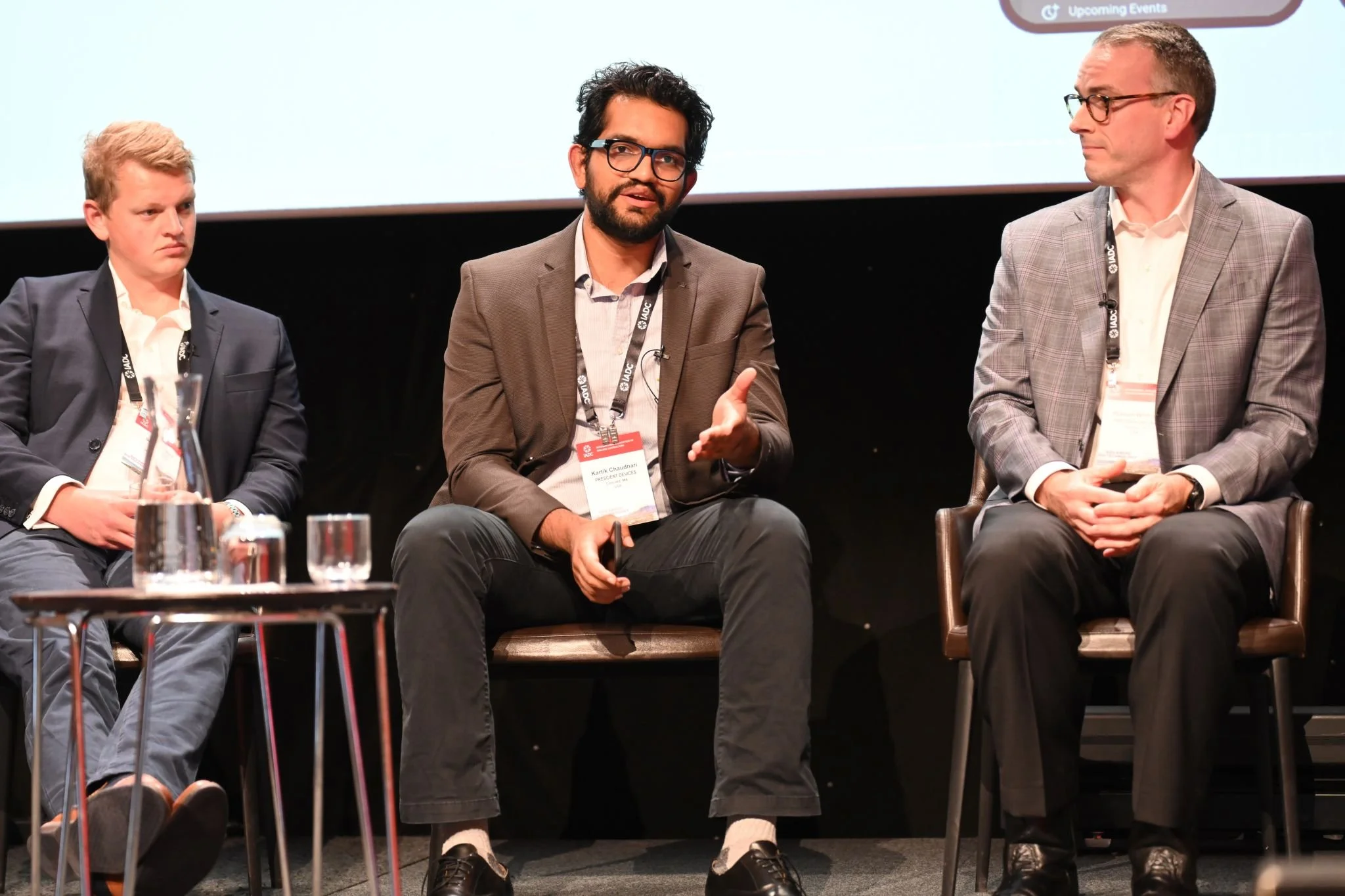
Session Chair: Alex Groh, Data Science Manager, Patterson-UTIA Transformer-Based Deep-Learning Model to Predict Asset Life and Normalize Asset Performance: Kartik Chaudhari, Machine Learning Lead, Prescient Devices & Russell Whitney, Global Innovation Manager, Precision Drilling, Pablo Acosta-Serafini, Andy Wang, Prescient Devices
A first-of-kind (FOK) Transformer-based Asset Life Model (ALM) is introduced. This deep-learning model enables the accurate forecasting of component lifetimes by operating hours, enabling predictive and proactive maintenance workflows. Discussions will include challenges in training, validating, piloting, and scaling such a solution as an augment to a commercially deployed operational digital twin.
September 30-October 1, 2025 | Reykjavik, Iceland
-
Unplanned equipment failures continue to pose a major challenge in drilling operations, leading to downtime, safety risks, and rising costs. This session will explore how IoT-enabled devices, enhanced data integration, and real-time predictive analytics are revolutionizing drilling teams' ability to proactively monitor and prevent failures in surface equipment such as top drives, mud pumps, and power systems. By connecting siloed data sources and leveraging advanced analytics, operators can detect early warning signs of mechanical stress, optimize maintenance planning, and improve equipment lifespan. The discussion will also highlight practical strategies for integrating modern analytics tools with legacy systems, empowering teams to shift from reactive troubleshooting to predictive failure prevention and operational excellence. (Excerpt from Darcy Partners event link)
Download the webinar deck presented by Precision Drilling
-
Distributed Database For Scaling Up Real-time EDR Data Processing
A. Wang, P. Acosta, Prescient Devices; R. Whitney, Precision Drilling
Abstract. This paper presents a novel distributed database architecture that supports processing over 1-Billion real-time Electronic Drilling Recorder (EDR) data points and 50-Million database queries per day. This architecture provides significantly better scalability, lower compute cost, and better fault tolerance as compared to monolithic database architecture to support large-scale, real-time rig digital twin and AI applications.
April 14 | Oklahoma City, OK
2024 Events
-
We are excited to participate in the MIT MTL Startup Showcase as part of the Microsystems Technology Laboratories' 40th anniversary celebration. Our founders, Dr. Andy Wang, Dr. Pablo Acosta, and Prof. Charles Sodini, all came from MTL, which built a solid foundation for our work in data system optimization. Join us at the showcase to see our distributed, graphical workflow technology to enable rapid implementation, iteration, and innovation of industrial and energy data solutions. The MTL40 celebration is jointly hosted with the MIT Research and Development Conference.
Link to 2024 MIT Research and Development Conference | Link to MTL40 Website
November 20, 2024 | Cambridge Marriott MIT -
Real-time Data Wrangling through Distributed Data Engine Technology: Russell Whitney, IIoT Manager, Precision Drilling, Andy Wang, CEO, Pablo Acosta-Serafini, Prescient Devices, Inc.
Our presentation introduces a distributed low-code data engine capable of working with massive real-time data from warehouses like Snowflake. This drag-and-drop, hierarchical, and graphical data workflow builder efficiently processes data for upstream analytics. It enables quick engineering of complex real-time data streams, supporting tasks like anomaly detection. The engine’s scalability allows easy deployment and customization, facilitating rapid scaling across rig fleets. We will then showcase how this data engine serves as the cornerstone for implementing a digital twin solution for rig operations, highlighting the transformative impact of rapid data wrangling on rig operations.
November 14-15, 2024 | Hyatt Regency San Antonio Riverwalk -
Scaling Data and AI for Upstream: Andy Wang, Ph.D., CEO, Prescient Devices Inc.
Data science is experiencing strong growth in oil & gas, but scaling data science solutions to production is still a major challenge. This talk will explore the top challenges in scaling production-grade data science solutions from generating high-quality data at massive scale to solving computing resource limitations and database bottlenecks. We will use a drilling digital twin solution as a use case to show how to scale this solution to support 100+ rigs and process 2.1-Billion real-time data points and 57-Million database queries per day
Link to University of Houston Seminar Details
Source: https://dot.egr.uh.edu/departments/ist/research/seminars
November 11, 2024 | Brazos Hall Building -
Building effective visualization for reliability monitoring: Nathan Reese, Manager Alpha Remote Operations, Precision Drilling, Andy Wang Ph.D., CEO, Prescient Devices Inc.
We will introduce advanced visualization techniques designed specifically for reliability monitoring in the manufacturing and energy sectors. We will demonstrate the effective use of visualization tools to anticipate potential failures and fine-tune maintenance schedules, ensuring superior operational reliability and efficiency.
Download the Presentation Deck
September 26, 2024 | Houston, TX -
Deploy distributed real-time data pipelines across cloud and edge to process rig data for easy data fusion and processing: Russell Whitney, IIoT Manager, Precision Drilling, Andy Wang, CEO, Pablo Acosta-Serafini, Prescient Devices, Inc.
We will showcase these technologies’ roles in enhancing predictive capabilities, optimizing resource allocation, and improving geological assessment accuracy. We will delve into advanced data analysis techniques that reduce uncertainties and enhance the efficiency of exploration and production processes.
-
Driving Intelligence at the Edge for Energy and Industrial Infrastructure: Matthias Wieland, Global Partnermanagement and Sales Head Europe, Bosch, CR Prahallad, Head of Customer Solutions, Bosch, Andy Wang, CEO, Prescient Devices Inc.
The Bosch* Digital Twin – Integrated Asset Performance Management (IAPM) improves plant machinery and processes by addressing predictable business challenges. It offers engineering insights to enhance Overall Equipment Effectiveness (OEE), reduce unplanned downtime and maintenance costs, and improve quality. Business insights from IAPM help understand asset criticality, improve plant efficiency, and lower failure mitigation costs through predictive maintenance. This approach supports Reliability Centered Maintenance and Total Productive Maintenance. Its modular design and collaborative, customer-involved solution building provide a unique, immersive experience.
Link to Intel’s Partner Alliance Signup Page
September 19, 2024 -
Real-time Data Wrangling through Distributed Data Engine Technology: Russell Whitney, IIoT Manager, Precision Drilling, Andy Wang, CEO, Pablo Acosta-Serafini, Prescient Devices, Inc.
Our presentation will introduce a distributed low-code data engine that efficiently processes real-time data for upstream analytics. This allows quick engineering of complex real-time data streams and supporting tasks like anomaly detection.
Download the Presentation Deck
August 27-28, 2024 -
Technical Talk: The Impact of High-speed, Real-time Data Pipelines on AI and Data Science in Oil and Gas Value Chain, Andy Wang Ph.D., CEO, Prescient
Many AI applications in the oil and gas industry require real-time data. However, this real-time data can come from variety of data sources: sensors, PLCs, SCADA systems, historians, and more. These data sources also have very different protocols, locations, data rates, and etc. This talk will speak on data pipeline technologies that can conquer these data disparity challenges at scale. Use cases in upstream from drilling to characterization to production will be discussed.
Download the Presentation Deck
July 23, 2024